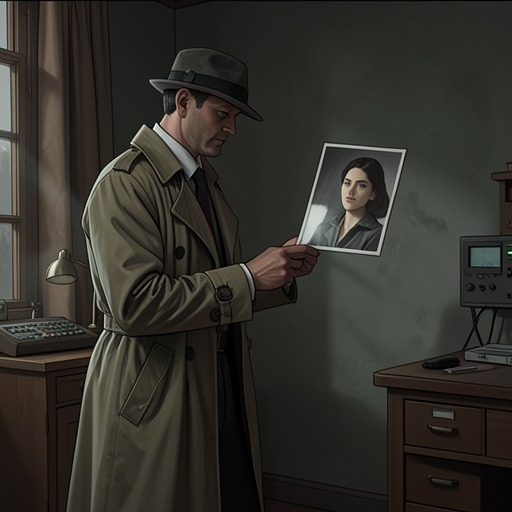
Maigret and Albert Falconi
Maigret and the Dead GirlMaigret and Albert Falconi are established adversaries whose encounter over Louise Laboine’s death brings their unequal kinds of knowledge into direct conflict. Maigret recognizes Falconi immediately and knows his criminal history; Falconi, in turn, must answer to an investigator who tests his account against the victim’s habits, circumstances, and discomfort in unfamiliar social settings. Their relationship is therefore both institutional and personal in its method: a police officer confronts a repeat offender, but the decisive pressure comes from Maigret’s attention to the particular person Falconi’s explanation attempts to describe.
Criminal History and Recognition
When Maigret enters the bar where Falconi works, he recognizes the barman at once. Falconi, a Corsican of about thirty-five, has been sent to prison by Maigret at least twice for running an unlicensed gambling house and once for trafficking in gold with Belgium. He was also arrested on suspicion of murdering a member of the Marseilles gang in Montmartre, but the authorities could not prove the charge and released him. The record establishes a history of contact without making every suspicion an established fact: Maigret has reason to know Falconi, but the earlier murder allegation remains unproven.
That accumulated history gives their first exchange a significance beyond an ordinary interview. They waste no words, and each sentence carries weight; the narration presents both men as seasoned professionals alert to what the other may infer. Maigret asks whether Falconi recognized the girl when he saw the Tuesday morning papers. Falconi neither denies recognition nor admits it, maintaining an impassive expression. His restraint does not end the questioning. It establishes the guarded terms on which the two men proceed: Maigret has identified his adversary, while Falconi offers no easy confirmation to work from.
From the Bar to Headquarters
Falconi is eventually taken to Headquarters. In the car he sits alone in the back, says nothing, and stares ahead as if trying to understand what is happening. Janvier is silent too, while Maigret smokes his pipe without speaking. The quiet continues the contest begun at the bar. Maigret does not fill the journey with accusations or try to force a response; Falconi’s silence is met by the investigator’s own.
At the office, Maigret refers to three other tough men, known as the wall borers, who confessed at three in the morning after eighteen hours there. He contrasts their prolonged questioning with Falconi’s having had enough after four hours, adding that several officers can take turns and that they have all the time in the world. The exchange presents time as an instrument of pressure, but not as the sole basis for the case. Maigret can keep Falconi answering; the more telling test is whether Falconi’s version withstands scrutiny.
Testing Falconi’s Account Against Louise Laboine
The distinction becomes clear when Maigret challenges the way Falconi has imagined Louise Laboine. He has spent time reconstructing her from what others said, including the concierge and Madame Crêmieux, and from the occasions when he saw her at Maxim’s and later among the guests at a wedding reception in the Roméo. He recalls that she wore a second-hand dress and a velvet cape that did not fit. For Maigret, those details are not incidental descriptions: they help establish how exposed and out of place Louise Laboine would have felt among strangers.
That understanding lets him question specific claims. He considers it unlikely that Louise Laboine would have sat down at Falconi’s bar, where she would have felt that customers were looking at her clothes. Even if she had sat there, Maigret argues, she would not have ordered a martini. He identifies Falconi’s answer as an automatic assumption that she behaved like the other women who came into his establishment. Falconi then admits that Louise Laboine drank nothing. Maigret also rejects the account that she went down to the basement to read a letter: the route would have taken her through a crowded bar, and he doubts she would have felt able to thread her way past the customers.
Maigret sets those judgments beside the postmortem report. The newspapers had said that Louise Laboine’s stomach contained alcohol, but had not reported that it was rum; a martini, he points out, consists of gin and vermouth. The difference undermines the drink in Falconi’s version. Earlier, Maigret had already revisited the report and reasoned that Louise Laboine must have been drinking either before the wedding reception, to give herself courage, or afterward, before her body was found on Place Vintimille. The forensic detail and the reconstruction of her behavior converge: alcohol was present, but the kind Falconi’s story implied did not fit the report.
Knowledge, Pressure, and the Unfinished Exchange
Maigret’s advantage is not simply that he possesses more evidence. He tells Falconi that the account initially seemed nearly perfect and might have persuaded him if he had not known the girl. The narrative pauses over Maigret’s attention to Louise Laboine rather than presenting his silence as a calculated performance. He is still thinking about her, and his reasoning depends on keeping her individual circumstances distinct from a generic picture of a woman who might visit Falconi’s bar.
The questioning narrows to the supposed letter. Maigret asks whether Falconi really gave Louise Laboine the letter. Falconi replies that he gave her a letter, and Maigret immediately distinguishes a letter from an envelope. The exchange shows the investigator testing not just the broad outline of a claim but the object at its center and the precision with which Falconi describes it. In the available scene, the distinction opens another question rather than supplying a final resolution.
Their relationship thus joins a history of arrests to a contest over credibility. Maigret knows Falconi as a repeat offender, yet he does not rely on that record to prove the present case; indeed, the earlier suspected murder ended without proof. Against Falconi’s composed reticence, Maigret accumulates differences: what Louise Laboine wore, where she would have felt at ease, what she drank, and what the medical report actually established. The confrontation’s force comes from the contrast between Falconi’s generalized account and Maigret’s specific reconstruction, which treats attention to Louise Laboine as a means of testing the suspect rather than as a substitute for evidence.